


Series “Brazil Through the Eyes of Public Leaders”: Fernando Haddad on Fragmentation, Reform and Brazil’s Future
In this debate, Fernando Haddad discussed the country’s main economic and political challenges. He also shared experiences from his trajectory in the federal government over the past few years.
Former Finance Minister Fernando Haddad warned that Brazil’s fragmented political system is making it harder for the country to pursue long-term strategies in areas such as climate policy, technological innovation and industrial development.
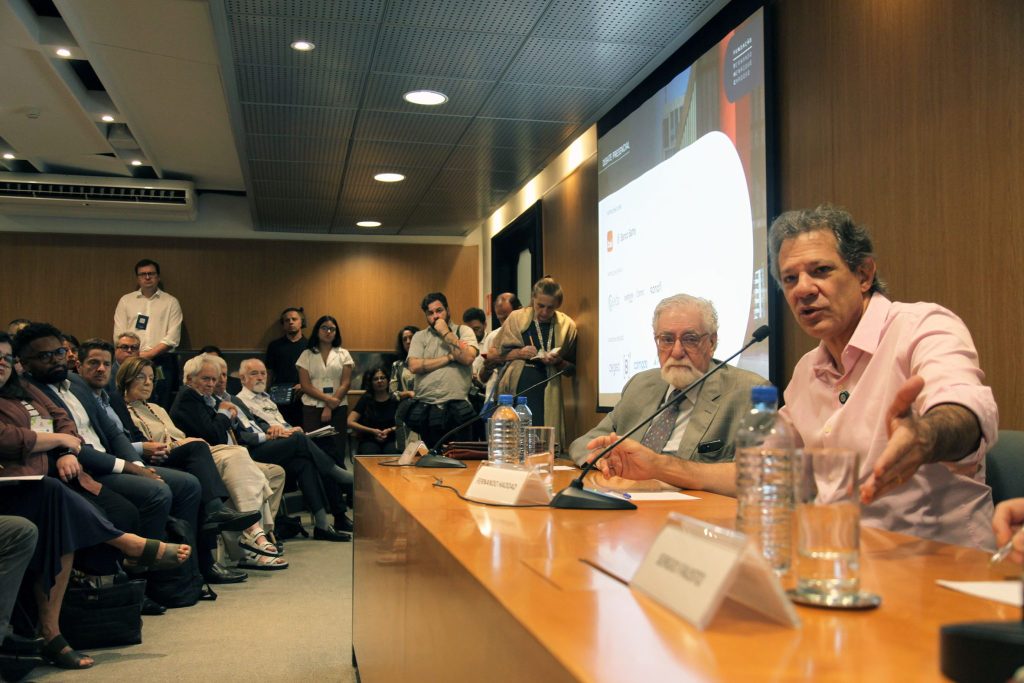
Speaking at the Fundação FHC on April 7, Haddad argued that weak coordination between ministries, Congress and different levels of government has slowed efforts tied to the green transition, productivity gains and reindustrialization.
“We have a great deal of fragmentation in the country. This leads to a lot of waste,” Haddad said. “A development strategy for Brazil requires coordination not only within the federal government, but also with states, municipalities and Congress.”
Haddad, who served as finance minister from 2023 to 2026 and previously as education minister and mayor of São Paulo, said the problem also exists within the federal administration itself. He cited the difficulties faced during the implementation of the Ecological Transformation Plan developed by the Finance Ministry during his tenure.
“Brazil has a natural advantage when it comes to making the green transition a driver of sustainable development,” he said. “But that requires coordination.”
He questioned whether ministries were working together effectively on issues such as reducing fossil fuel dependence, investing in new biofuels and developing Brazil’s rare earth industry.
“One minister thinks a certain issue belongs to him, another thinks a different issue belongs to him, when in reality they are all interconnected,” Haddad said. “A great deal of energy ends up being spent coordinating interests around goals that should belong to everyone.”
According to Haddad, the lack of coordination extends beyond Brasília. He questioned whether the federal government has sufficiently strong channels of dialogue with states and municipalities to build a shared vision for the country’s future.
Building Strategic Consensus
Haddad also criticized Congress for allowing a provisional measure aimed at encouraging investment in data centers to expire without a vote.
“An enormous volume of investment could have entered the country,” he said.
He argued that Brazil needs broader political alignment around strategic national projects, including participation from the opposition.
“How do you persuade the opposition to set aside political disputes and collaborate on projects of national interest?” he asked. “One way is to present proposals with strong public support, as happened with the Tax Reform.”
The former minister cited the tax overhaul approved in 2023 as an example of the kind of political coordination he believes Brazil needs in order to sustain long-term growth.
Without directly addressing the Supreme Court’s current credibility crisis, Haddad also defended reforms aimed at making Brazilian institutions more transparent and improving relations between the branches of government.
“The institutions are functioning,” he said. “The investigations underway need to continue so the country can move forward. But we also need to improve institutional relations.”
“If It Isn’t Driven by Populism, Brazil Has a Future”
Reflecting on his years at the Finance Ministry, Haddad said he had tried to balance fiscal discipline with social priorities. Despite Brazil’s political tensions, he argued that the country remains well positioned for a new cycle of growth if future governments act responsibly.
“We carried out a tax reform that was the most significant economic reform since the Real Plan,” he said, referring to the stabilization program launched in 1994. “If future governments behave responsibly, Brazil could enter the next decade in a stable position.”
Haddad said investors were closely watching whether Brazil could sustain a stable and responsible economic course, without abrupt policy shifts.
“If they believe this path is sustainable, many investments will come sooner than expected, and Brazil will grow more vigorously,” he said.
He concluded on an optimistic note.
“Setting aside the current noise — which is loud and sometimes discouraging — Brazil is in a good position to make a major leap forward,” he said. “Politics will determine whether we seize this opportunity or waste it. If the country avoids populism and radicalism, Brazil has a future.”
The Left and the Crisis of Political Imagination
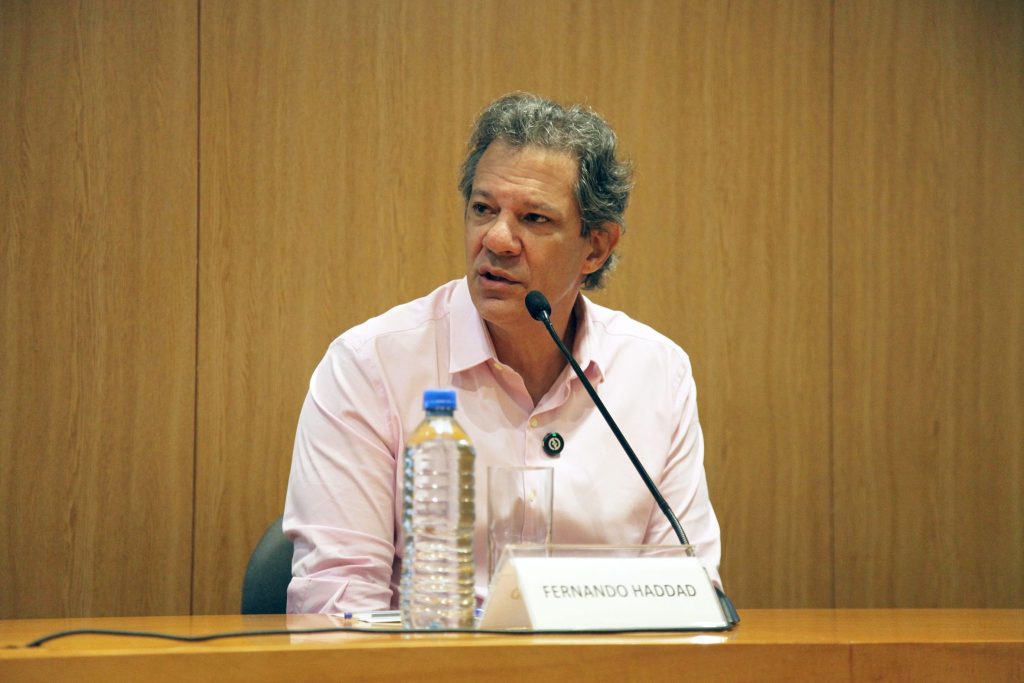
During the discussion, Sergio Fausto, executive director of the Fundação FHC, relayed a question from political scientist Marta Arretche about the difficulties progressive movements face in articulating a compelling vision for the future.
Haddad responded that the left today struggles to formulate a project capable of mobilizing society.
“The left seeks to transform reality, and that is more difficult than adopting a conservative or reactionary position,” he said. “It is easy to idealize a past that never really existed.”
According to Haddad, many of the political and economic models that shaped progressive movements during the 20th century lost their mobilizing power after the end of the Cold War.
“What once inspired hope — communism, social democracy, developmentalism — lost much of its force as a utopian horizon,” he said.
Haddad added that part of the left eventually absorbed the idea that there were no longer meaningful alternatives to the liberal democratic model that emerged after the collapse of the Soviet Union.
“We fell, to some extent, into the ‘end of history’ narrative,” he said, referring to the thesis advanced by political scientist Francis Fukuyama.
At the same time, he argued, the rise of the far right has pushed progressive forces into a more defensive posture.
“When the future itself begins to feel threatening, the instinct is often to protect what already exists rather than imagine something new,” Haddad said.
Fear, he argued, has become one of the main obstacles to political ambition.
“If we are unable to confront the fear surrounding the future, we will not move forward,” he said. “We cannot be afraid to compete with the far right over the future.”
Haddad also linked the rise of the far right to the deterioration of democratic debate.
“For roughly 30 years, Brazil had competing political forces that nevertheless recognized each other as legitimate,” he said. “That created room for ambitious projects because there was confidence that the country would continue to be governed responsibly, regardless of electoral outcomes.”
“The far right is a major obstacle,” he added. “This atmosphere of permanent threat makes it harder to think big.”
The São Paulo Race
Asked about a possible run for governor of São Paulo in 2026, Haddad said he initially resisted the idea because his focus remained on national politics. According to him, President Luiz Inácio Lula da Silva insisted on the need for a strong candidacy in the state.
“My attention was focused on national issues,” Haddad said. “But the president insisted that we needed a competitive candidate in São Paulo.”
He said that after examining the current state administration more closely, he found a more troubling situation than he had expected.
“There are many problems that I believed had already been resolved or at least addressed,” he said.
According to Haddad, he spent weeks meeting with specialists and former officials from previous São Paulo administrations in areas such as education, public safety, health care and infrastructure.
“If I criticize Governor Tarcísio de Freitas, I need to know exactly what I’m talking about,” he said. “That’s my style.”
He also said there was growing dissatisfaction among police officers, teachers and mayors across the state, particularly regarding public security policies.
Haddad said he intends to focus his campaign on technical proposals and substantive debate.
“The voter is sovereign,” he said. “But as long as I’m breathing, I’ll continue fighting for the causes I believe in.”
The Means and Ends of Politics
Closing the event, Celso Lafer, president of the Fundação FHC, praised the conceptual depth of Haddad’s remarks, particularly his reflections on the relationship between political objectives and the instruments of government.
“Governing means making choices, and those choices are never simple,” Lafer said.
He also highlighted what he described as Haddad’s enduring concern with social justice and long-term public policy goals.
“You presented a way of connecting means and ends,” he concluded.
Otávio Dias is a content editor at the Fundação FHC. A journalist specializing in politics and international affairs, he was a London correspondent for Folha de S.Paulo and editor of the website Estadão.