Challenges for Latin America in an Era of Great-Power Rivalry
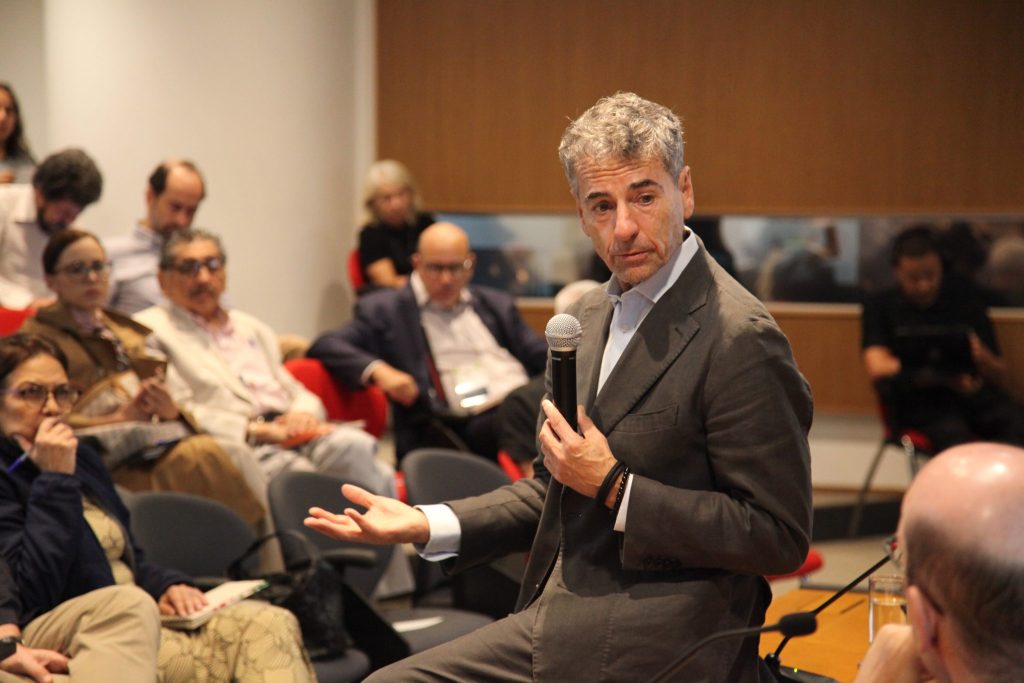
In a debate at Fundação FHC, Andrés Velasco argued that, in a deeply unstable world, Latin America should avoid automatic alignments, strengthen regional integration, and diversify its partnerships.
The international order that emerged after World War II is entering a period of profound instability. The United States — long seen as the world’s leading military and economic power, a guarantor of international security and a defender of liberal democracy — no longer appears willing to play the stabilizing role it once claimed for itself.
In this new environment, where “hegemonic power has become predatory,” Latin American countries should strengthen regional integration, diversify strategic partnerships and avoid excessive dependence on any single global power, according to Andrés Velasco.
Speaking at the Fundação FHC in São Paulo on April 9, Velasco argued that Latin American countries should strengthen regional integration — including through blocs such as Mercosur — deepen ties within the region itself and diversify partnerships with emerging economies in Asia, the Middle East and Africa.
At the same time, he warned against viewing China as a substitute for the United States. China has already become the leading trading partner for most South American countries and continues to expand its investments across the region, particularly in infrastructure, energy and technology. But, Velasco argued, closer economic ties with Beijing should not translate into automatic geopolitical alignment.
“With Donald Trump’s return to the White House, the great eagle that once watched over the world has become a predator,” Velasco said, citing political scientist Stephen Walt’s description of the United States as a “predatory hegemon.”
Velasco, who served as Chile’s finance minister from 2006 to 2010 and now directs the School of Public Policy at the London School of Economics and Political Science, argued that the transformation underway in the United States goes beyond Trump himself.
“What is happening in the U.S. today is not just about one president,” he said. “It reflects a deeper cultural rupture with the international order the country itself helped build over the last 80 years.”
Russia’s invasion of Ukraine and growing instability in the Middle East, he argued, have reinforced a broader shift in global politics in which military strength, technological autonomy and economic resilience have regained central importance.
“Global politics has once again come to demand muscle,” Velasco said.
A Broader Definition of Security
Velasco organized his analysis around three dimensions of security that, in his view, increasingly shape international relations: physical, economic and technological.
The first is physical security. Europe’s rearmament following Russia’s invasion of Ukraine illustrates how military capability has returned to the center of geopolitical strategy. But the issue extends beyond conventional defense spending. It also involves access to strategic technologies — including satellites, communications systems and cybersecurity infrastructure — without creating new forms of dependency on either Washington or Beijing.
In Latin America, he noted, physical security also includes combating organized crime, which increasingly operates through transnational networks.
The second dimension is economic security. Velasco argued that many assumptions associated with globalization no longer hold. Access to markets, financing and supply chains has become more vulnerable to geopolitical tensions and political decisions.
“Access to markets is no longer guaranteed,” he said. “Access to critical inputs is no longer guaranteed either.”
Competition for energy resources and strategic minerals — essential for sectors such as semiconductors, batteries and artificial intelligence — is becoming increasingly central to global economic competition.
The third dimension is technological security, which Velasco described as perhaps the most consequential in the long term. Governments, companies and critical infrastructure increasingly depend on cloud systems controlled largely by American technology firms, while the United States and China dominate the development of advanced artificial intelligence.
“If those two countries decide to exclude others from these technologies, there is very little the rest of the world can do,” he warned.
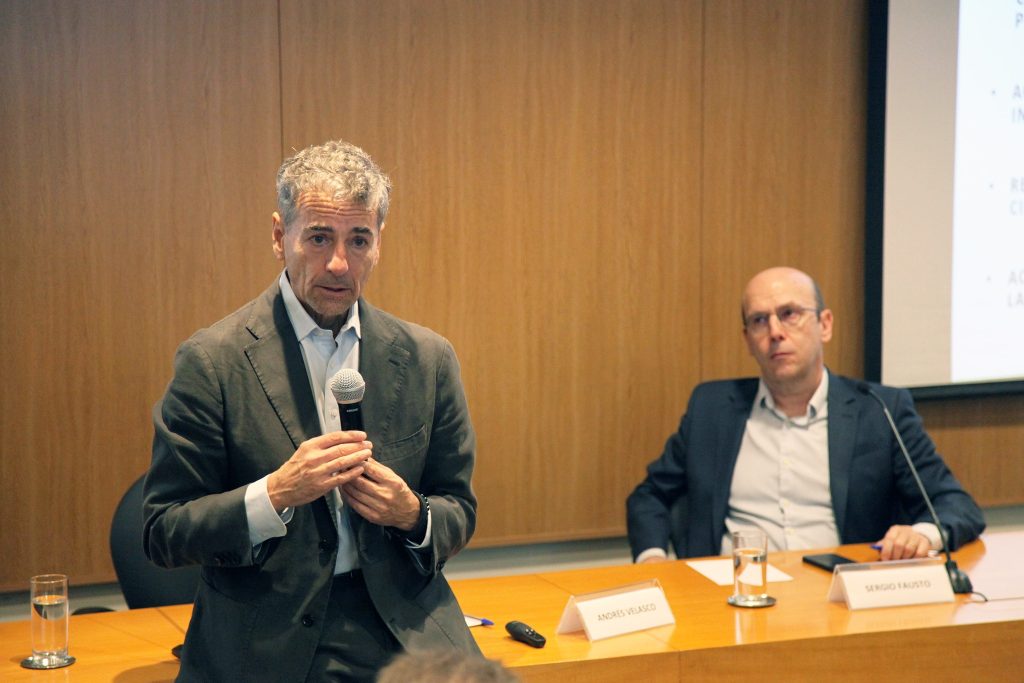
Photo: Vinicius Doti
Latin America’s Strategic Dilemma
This new geopolitical landscape, Velasco argued, leaves Latin America facing a difficult balancing act.
Automatic alignment with one of the major powers may offer short-term advantages but also creates vulnerabilities.
“Being friends with a predator isn’t very safe,” he said.
At the same time, strict neutrality may prove unrealistic in a world increasingly shaped by geopolitical rivalry, trade disputes and technological fragmentation.
Velasco argued that Latin American countries should seek greater room for maneuver by diversifying alliances and strengthening regional coordination rather than binding themselves too closely to any single power.
“We can have more than one friend,” he said.
He also cautioned against transforming the BRICS bloc into a rigid geopolitical alliance. In his view, the group currently functions more as a platform for influence — particularly for China and Russia — than as an effective mechanism for deep economic or technological integration.
Beyond foreign policy, Velasco argued that Latin America’s biggest vulnerabilities remain internal. Productivity growth across much of the region has stagnated, innovation remains weak and the gap separating Latin American economies from the technological frontier continues to widen.
“Brazil and Mexico are growing more slowly than advanced economies,” he said. “That goes against the logic of convergence.”
One major obstacle, he argued, is the weak relationship between universities and the productive sector. Countries capable of sustaining long-term growth tend to build innovation ecosystems in which academic research, private investment and state coordination reinforce one another.
Diversification and Pragmatism
Given growing uncertainty surrounding the global economy — including geopolitical tensions, inflationary pressures, technological rivalry and doubts about the sustainability of current financial valuations — Velasco argued that Latin America should adopt a strategy centered on pragmatism and diversification.
“Since we don’t know what will happen, we must act prudently,” he said.
That means expanding partnerships, strengthening ties within Latin America and pursuing agreements with countries and regions beyond the traditional U.S.-China axis. Velasco pointed to the Mercosur-European Union trade agreement, closer ties with India and greater regional integration as examples of potentially important strategic alternatives.
“If one partner behaves badly,” he said, “you need other partners.”
The “London Consensus”
Velasco also discussed what he described as the emerging “London Consensus,” a still-evolving attempt to rethink economic policy frameworks in a world marked by geopolitical fragmentation and greater systemic risk.
Unlike the market-oriented Washington Consensus of the 1990s, the new approach places greater emphasis on resilience, strategic autonomy and the state’s role in mitigating economic shocks. At the same time, it maintains support for central bank independence and fiscal responsibility.
Rather than offering a fixed ideological model, Velasco argued, the emerging framework reflects a broader recognition that economic efficiency alone is no longer sufficient in a world increasingly shaped by security concerns.
For Latin America, he said, the implications are clear. Advanced economies are already reorganizing around new geopolitical and technological realities. If the region fails to adapt, it risks once again remaining on the margins of global transformation rather than helping shape it.
“A strong Europe matters not only for Europeans, but for the balance of the world,” Velasco said toward the end of the discussion, broadening the argument beyond Latin America itself.
Closing the event, Celso Lafer, president of the Fundação FHC, argued that Brazil and Europe continue to share democratic values and political affinities that could support closer cooperation in an increasingly unstable international environment.
As former President Fernando Henrique Cardoso once argued, Lafer said, South America represents “another West” — one that shares with Europe not only economic interests, but also a broader conception of democracy, pluralism and life in society.
Otávio Dias is a content editor at the Fundação FHC. A journalist specializing in politics and international affairs, he was a London correspondent for Folha de S.Paulo and editor of the website Estadão.