Brazil in the energy transition and the role of oil
The debate had two panels, one more general, entitled “Brazil in the energy transition and the role of oil,” and another more specific one that sought to answer the following question: “Should we explore the Equatorial Margin?”.
The energy transition, which is essential to mitigate the effects of climate change, is non-linear and multidimensional: it is more a process of adding renewable sources to each country’s energy mix than an attempt to rapidly replace the use of fossil fuels.
Demand for oil and natural gas as energy sources is likely to remain strong for several decades, especially in developing countries such as India, one of the world’s fastest-growing economies, and in less developed countries, which have limited resources to accelerate their transition.
Brazil, which has a greater variety of energy sources than most other countries, both renewable and non-renewable, with a predominance of the former, is in a privileged position to benefit from this process. Unlike other countries, particularly developed ones, the energy sector does not account for the majority of Brazilian emissions.
The country is ahead of most others in the energy transition. This does not mean that it does not face challenges in preserving and expanding its renewable energy sources—just consider the importance of preserving and restoring the Amazon rainforest to avoid prolonged and frequent droughts that compromise hydroelectric power generation. There are also opportunities to further advance the production of biofuels for both land and air transportation.
As for the decision on whether or not to explore the so-called Equatorial Margin — which stretches for about 2,800 km along the Atlantic coast, from the coast of the Brazilian states Amapá to Rio Grande do Norte — there are arguments for and against. One thing is certain: if it wants to comply with the NDC presented in 2024 by the current government, Brazil will not be able to explore the reserves that potentially exist in the Equatorial Margin.
If the existence of oil reserves is confirmed and the country wants to explore them, oil production in that area will only begin around 2035, with an estimated end date of 2060. Those in favor of this option argue that there will still be global demand for many decades to come and that Brazil will receive nothing in return if it does not meet that demand.
Those who oppose exploration of the Equatorial Margin point out, in addition to the environmental risks, the uncertainty regarding the return on investment, since the acceleration of climate change may necessitate a faster transition to renewable energy sources.
“The final decision will not be made by any agency or minister. It will be Lula’s. It is the president of the Republic who will make the final call,” said Jean-Paul Prates, who chaired Petrobras from January 2023 to May 2024, at this seminar held by the Fundação FHC and the Instituto Arapyaú. Part of the Environment and Development cycle, the event featured two panels, one more general, entitled “Brazil in the Energy Transition and the Role of Oil,” and another more specific one that sought to answer the following question: “Should we explore the Equatorial Margin?”.
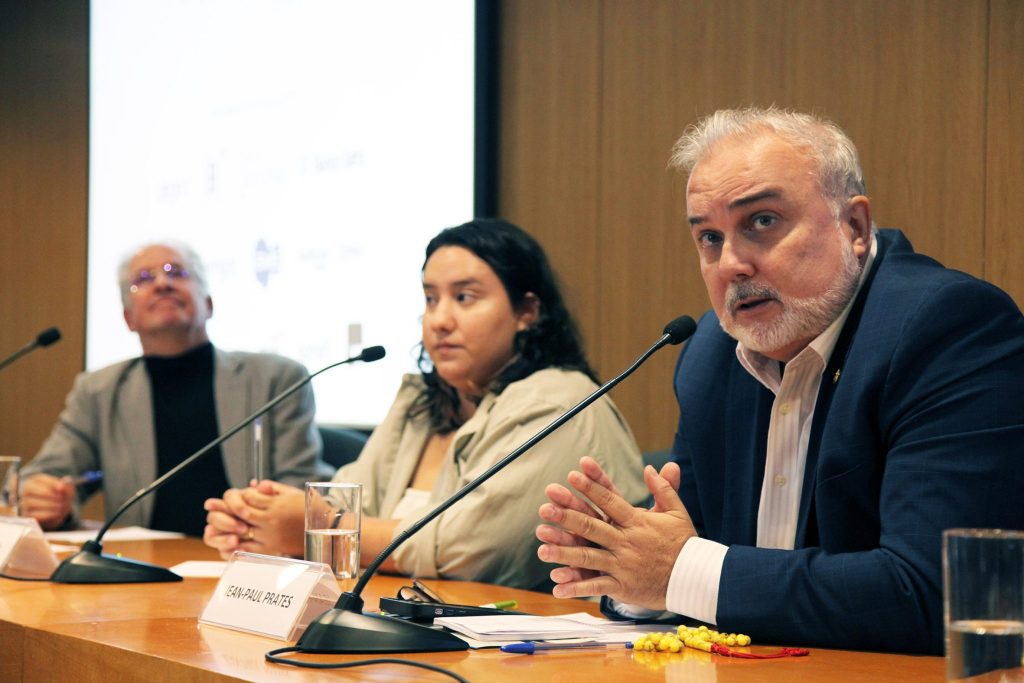
Photo: Vinicius Doti
Brazil is a global benchmark in sustainable oil exploration in the Atlantic
“The energy transition underway on the planet brings a new concept, which is the addition of new renewable energy sources, not the pure and simple replacement of energy from oil and other fossil fuels. It is a non-linear and multidimensional process, which varies greatly depending on the region and country,” said David Zylbersztajn, former director-general of the National Petroleum Agency (ANP).
Zylbersztajn, a professor at the Energy Institute (IEPUC), pointed out that India and China, the most populous nations on the planet, have only committed to zero emissions after 2060: “An Indian today consumes on average 22 times less energy than an American. With the country’s rapid growth, it is inevitable that India will continue to have a strong demand for oil-based energy. And as long as there is demand, there will be supply.”
According to Zylbersztajn, Brazilian oil exploration, especially in the Pre-Salt layer, emits 40% to 50% less CO2 than that carried out in other major producing countries and, for this reason, it would not make sense for the country to stop exploring possible new reserves, such as those in the Equatorial Margin, if they are confirmed. “Brazil is a global benchmark in oil production in the Atlantic Ocean, both from a safety and sustainability perspective. We don’t have to set an example for anyone because we are already doing our part,” he said.
Brazil’s goal of zero emissions by 2050 is unattainable if new reserves are explored
“If Brazil really intends to comply with the latest NDC (Nationally Determined Contribution), it can forget about exploring the Equatorial Margin. Will the government do what it promised, or is the NDC just for show?” said Roberto Schaeffer, professor of Energy Economics at COPPE/UFRJ.
In 2024, the Lula administration published an NDC — a commitment that each signatory country to the Paris Agreement voluntarily undertakes to reduce its greenhouse gas emissions — in which it set itself the goal of zeroing total emissions of these gases by 2050.
“The Brazilian NDC includes not only CO2 emissions, but all greenhouse gases, including methane (produced by cattle during digestion) and nitrous oxide (N2O). The latter will never reach zero, so Brazil needs to reduce CO2 emissions to zero between 2035 and 2040 and become negative (i.e., retain more CO2 than it emits) after that. To fulfill this commitment, there is no other option but to significantly reduce oil production. The time for searching for new oil is over,” continued Schaeffer, who participated in the drafting of Brazil’s new NDC.

Photo: Vinicius Doti
To meet the target, he pointed out, the country will also have to drastically reduce illegal deforestation in the Amazon—currently, land use, especially deforestation and land-use changes, is one of the main sources of CO2 emissions, accounting for a significant portion of total Brazilian and global emissions—and the consumption of diesel and aviation kerosene.
“In a few years, 100% of Brazilian buses and trucks will have to run on biofuel or electricity, and aviation kerosene will have to be replaced by SAF (Sustainable Aviation Fuel). The path to zero total emissions by 2050 has a significant cost, but it can also generate value and opportunities in several areas,” he said.
Brazil misses opportunity to discuss role of oil with maturity
“If it weren’t for the climate emergency, I would be a staunch supporter of oil, as the use of oil and gas to produce energy is very efficient and has enabled a great leap forward in civilization. However, the issue of climate change is pressing. It is estimated that the energy transition will cost 5% of global GDP, but the cost of doing nothing is unpredictable and falls on societies as a whole,” said Shigueo Watanabe Jr., a contributor to Clima Info.
Shigeo also criticized the controversy surrounding the authorization of research in block 59, located about 160 km off the coast of Amapá and more than 500 km from the mouth of the Amazon River: “It has become a battle horse, and so we are missing the opportunity to discuss the role of oil in the country’s development with more maturity, breadth, and depth.”
In Amapá, voices critical of exploration are being silenced
“The energy transition should not just be a change in energy sources in the energy matrix, but a fair and equitable transition. This is hardly ever discussed on a daily basis. Much less in Amapá, where the only idea being sold is that oil will bring development, but at what cost?” said Flávia Guedes, project analyst at the Mapinguari Institute, which has been working since 2015 for the sustainable development of the Amazon.
“Everyone wants to improve their quality of life, and the population of Amapá is in dire need of investment, jobs, training, and opportunities. But this will not happen with oil exploration on the Equatorial Margin, as has been the case in the vast majority of Brazilian municipalities located in oil exploration areas. Who would this development benefit? This is what we need to discuss, but in Amapá, critical voices against exploration are being silenced,” she continued.
According to Guedes, the state does not have the public services to cope with the interest that the possibility of oil exploration in the region is already generating: “This will cause a large migration from other states to Amapá and reignite the violence we have suffered in the past. Communities want to be heard and participate in decision-making, but not even the most basic prior consultation is being carried out.”

As an example of the lack of return to the population, the environmentalist recalled the blackout that occurred in Amapá in 2021: “We have four hydroelectric plants in our state. When they were built, the promise was that they would bring development and progress. But even after suffering adverse effects, such as river droughts, loss of biodiversity, and changes in the way of life of thousands of people, we went 23 days without power in the middle of a pandemic. And that was it.”
Guedes, who came from Amapá especially to participate in the seminar, concluded by saying that the bioeconomy is the best way to develop Amapá: “We have enormous potential to produce food and other products while preserving the forest, the rivers, and our way of life. But the bioeconomy is not taken seriously by those who make decisions in Macapá (capital of Amapá) and Brasília.”
For former Petrobras president, the final decision will be made by President Lula
“Petrobras has an obligation to do everything in its power to explore the Equatorial Margin. Ibama, on the other hand, has the prerogative to bring the environmental dimension to the table. But the final decision will not be made by any agency or minister. It will be made by the president of the Republic,” said Jean-Paul Prates, who chaired Petrobras from January 2023 to May 2024.
According to Prates, Petrobras is technically prepared to explore for oil in a sensitive region such as the area off the mouth of the Amazon River: “Petrobras is the best offshore oil company in the world. It is accustomed to extracting oil from the seabed safely and sustainably. If there is oil in the Equatorial Margin, it has all the conditions to explore it.”
He noted, however, that there are several steps to be taken before this becomes a reality. “There is a whole sequence of actions, starting with an operational assessment, followed by the issuance of a research license and the drilling of the first wells to find out if there is oil. Guyana (near Amapá) drilled 60 wells before finding huge reserves. Then you have to make an exploration plan and build the infrastructure. If all goes well, production will only start around 2035 and end in 2060 or 2070,” he explained.
“Will the world still demand oil in a few decades? We don’t know. What we do know today is that we are experiencing an energy evolution, in which new renewable energy sources are becoming increasingly important, but oil continues to play a role. Brazil is fortunate to have a multitude of energy sources, both renewable and non-renewable. We have many stars, which ones to choose? It is up to the Brazilian government to know how to manage this gift that few countries have,” concluded Prates.
Oil resources can contribute to the preservation of the Amazon
According to Henri Philippe Reichstul, who was president of Petrobras from 1999 to 2001, the financial resources collected by the Brazilian government from royalties and taxes resulting from oil exploration in the Equatorial Margin could be important for investing in the preservation of the Amazon rainforest in Amapá and other states in the region.
“It is easier to avoid or mitigate any problems arising from the activities of oil companies in the region, whether Petrobras or other duly constituted companies, than to deal with illegal mining, loggers, and drug traffickers, who today operate almost freely in the Amazon. The more resources we have to invest in preservation, the better. Oil can contribute to this, if the executive and legislative branches so determine,” said Reichstul, who was in the audience and asked to speak during the question and answer session.
Learn more:
Initiatives for a Sustainable Amazon: a dialogue between Marina Silva and Ilan Goldfajn
Environment and development: the opportunities of decarbonization and how to take advantage of them
Otávio Dias is content editor at the Fundação FHC. A journalist specializing in politics and international affairs, he was a correspondent for Folha in London and editor of the website estadao.com.br.