


Series “Brazil through the eyes of public leaders”, with Minister Edson Fachin, President of the Brazilian Supreme Federal Court
The minister presented his analysis of the main challenges he will face during his term as President of the Brazilian Federal Supreme Court, a position he assumed in September for a two-year term.
“I believe it is simplistic to imagine that it is the Supreme Federal Court that is under attack (in Brazil). What is under attack is an institution that is working to curb violations of the 1988 Federal Constitution and curb attempts to ruin our democracy. If it were another institution, it would also be under attack. Therefore, what is under attack is the Democratic Rule of Law, the republican Constitution that made it possible to reinstate democracy in Brazil in 1988,” said STF Minister Edson Fachin in a lecture at the Fundação Fernando Henrique Cardoso on August 4, 2025.
In his initial presentation of about 30 minutes, Fachin – who took office as President of the Supreme Court on September 29th – said that the Supreme Court needs to exercise strategic self-restraint, intervening to protect democracy, but not to govern it. “The Supreme Court is not the sole arbiter of the democratic game. It is clear that the Court plays a crucial role in protecting the Federal Constitution and containing authoritarian risks, but the vitality of Brazilian democracy requires that all actors – the executive, legislative, parties, press, and civil society – act with restraint and within the rules of the game,” he said.
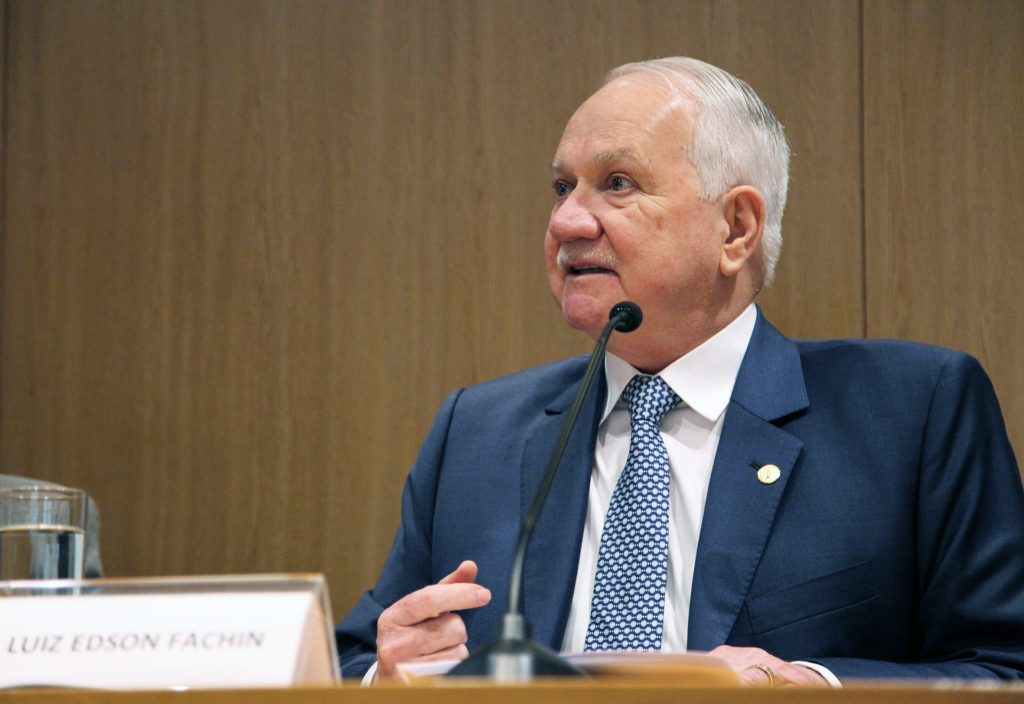
“The complexity of Brazilian society – marked by regional diversities, social pluralism and inequality – requires a networked democracy, in which the STF does not decide alone, but is anchored in a network of oversight and deliberative institutions, which includes bodies such as the Public Prosecutor’s Office, the Courts of Auditors, the Office of the Comptroller General, the National Council of Justice, and even certain regulatory agencies,” he continued.
“This vision of institutional interdependence is more faithful to the spirit of the 1988 Constitution, which sought to pluralize power and socialize the defense of the rule of law, and offers an antidote to the excessive personalization of constitutional politics in 11 ministers. In short, the path to a mature democracy lies less in the concentration of power in the STF and more in the strengthening of an institutional ecology, where multiple bodies, parties, and civil society itself share the responsibility of sustaining the democratic pact,” said Fachin, invited to participate in the lecture series “Brazil in the view of public leaders,” initiated by the Fundação FHC in February 2024.
“Winds blowing from the North, however strong they may be, will not haunt us.”
At the end of the event, Fachin criticized US President Donald Trump’s decision to apply the Magnitsky Act against Supreme Court Justice Alexandre de Moraes for his role in the proceedings involving former President Jair Bolsonaro and others accused of attempting a coup:
“Punishing a judge for decisions he has made is a terrible example of undue intervention. Even more so when it comes from a foreign country in relation to another sovereign country. Therefore, I do not think it is a reasonable course of action. On the contrary, it is undue interference, which acts as a kind of threat. But, as I said, we are from a generation that has already lived under threat, and we will not be frightened by these winds blowing from the North, no matter how strong they may be. I believe that we have accumulated experience in defending democracy and the democratic rule of law and, especially, judicial independence and autonomy. One may agree or disagree with the decisions of a particular judge. When one disagrees, one can appeal or criticize it publicly . This is characteristic of democracy. But to punish in this way, or even to punish internally, a judge for a decision made because of the political or ideological effects of a decision, is absolutely wrong. It is an offense to the most basic principles of judicial independence and autonomy. I believe that this new pandemic, the pandemic of global populist authoritarianism, may victimize institutions and courts in other countries. And I hope that everyone, including together, will know how to resist these circumstances.”
‘The power of the STF Presidency to set the agenda must be used boldly and prudently’
“You state the need for the Federal Supreme Court to exercise self-restraint, which has been unusual among STF justices. How can this self-restraint be put into practice at a time when the Supreme Court is under attack from enemies of the Federal Constitution? How can this political-institutional move be made in a house that is quite fragmented and that encourages individual actions that are sometimes exacerbated?” asked Oscar Vilhena Vieira, professor of constitutional law at the Fundação Getulio Vargas, who was invited to comment on the minister’s speech.
“The issues raised by the professor challenge all of us who are Supreme Court justices to say more with less, to speak more by saying less. Because there are several ways to declare, and many of them, paradoxically, are strictly ‘declarative’. Those who decide a given case speak through their decision. This is the privileged locus of a judge, to speak through their decisions,” he replied.
After stating that he was “in no hurry” to assume the position of President of the STF, Minister Fachin made it clear that he intends to exercise his power over the agenda and schedule to direct, as far as possible, the work of the court during his two-year term. “With regard to who is assigned the Presidency of the Court, there is the exercise of setting the agenda and schedule. The search for balance means exercising this faculty or this power of agenda in a manner that is consistent with the reality we experience. It is necessary to act with boldness, but with prudence,” he said.
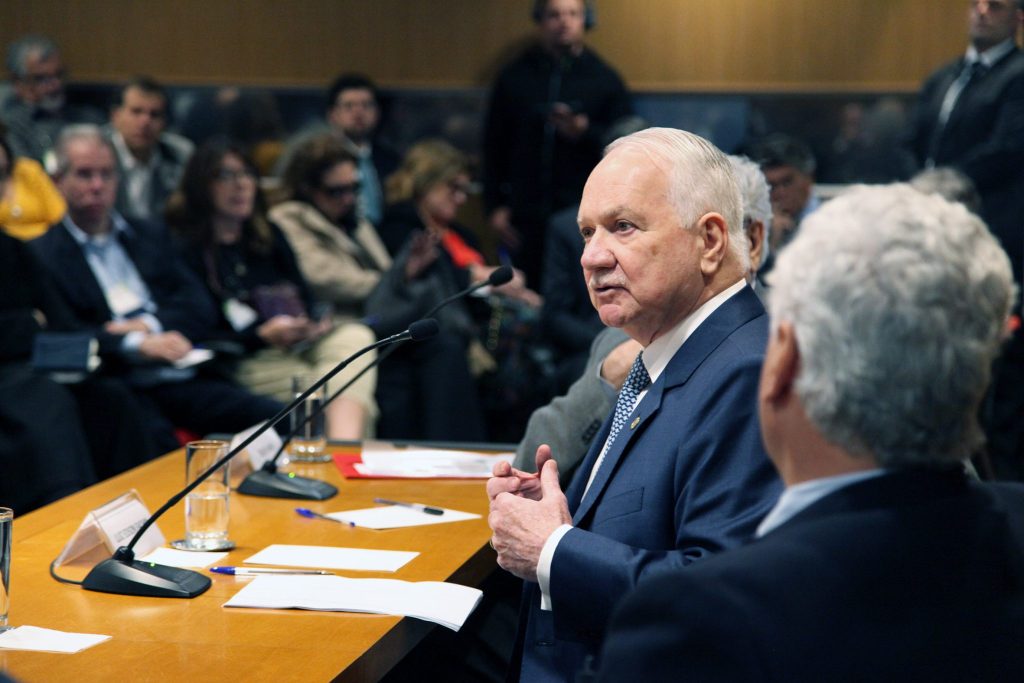
In an exercise of self-restraint, Justice Fachin avoided answering questions on issues that are likely to be reviewed by the Supreme Court in the near future, such as the application of the Amnesty Law (1979) in cases of disappearances during the military dictatorship: “This is an issue that may return to the Supreme Court’s agenda, and therefore I cannot comment on it. But I suggest that the author of the question read some of the votes I have already cast on this matter. One of them is a decision I made on the extradition of an Argentine in which I dealt with this issue, albeit tangentially.”
Asked about the importance of “a positive agenda to safeguard the rights of indigenous peoples,” Fachin indicated that the Supreme Court should take a position on the law establishing a time limit for the demarcation of indigenous lands, approved by the National Congress in 2023, shortly after the STF declared the time frame thesis unconstitutional.
“With regard to indigenous peoples, the Federal Constitution has a clear mandate, especially in Article 231. In relation to indigenous peoples, in the extraordinary appeal for which I was the rapporteur, and which has already been judged by the Supreme Court, I was able to make my view clear. After this ruling, Congress reacted by passing a law to the contrary. This created tension, which needs to be dissolved. This will be done through the exercise of the agenda-setting power of the Presidency of the STF.”
When asked if there were too many monocratic decisions in the Supreme Court—decisions made by a single justice rather than by the full court—Fachin indicated that there is already a way to avoid the so-called “collegiality deficit” that, according to some critics, undermines the court’s authority.
“If excessive, monocratic decisions are a pathology. If absent, they can cause offense to some rights or some measures that are in fact urgent. Therefore, eradicating monocratic decisions is not the way forward. We must follow the middle path, which was already defined during Minister Rosa Weber’s successful tenure as President of the STF (2022-2023). When a minister grants an injunction, the virtual plenary must be called to endorse it or not. As in other situations, we must seek balance,” he concluded.
Learn more:
The role of the STF in defending democracy – Lecture by Alexandre de Moraes in August 2023
Watch the fifth season of the series ‘Vale a Pena Perguntar’ on the Brazilian political system and the quality of democracy
Otávio Dias is content editor at the Fundação FHC. A journalist specializing in politics and international affairs, he was a correspondent for Folha in London and editor of the website estadao.com.br.